

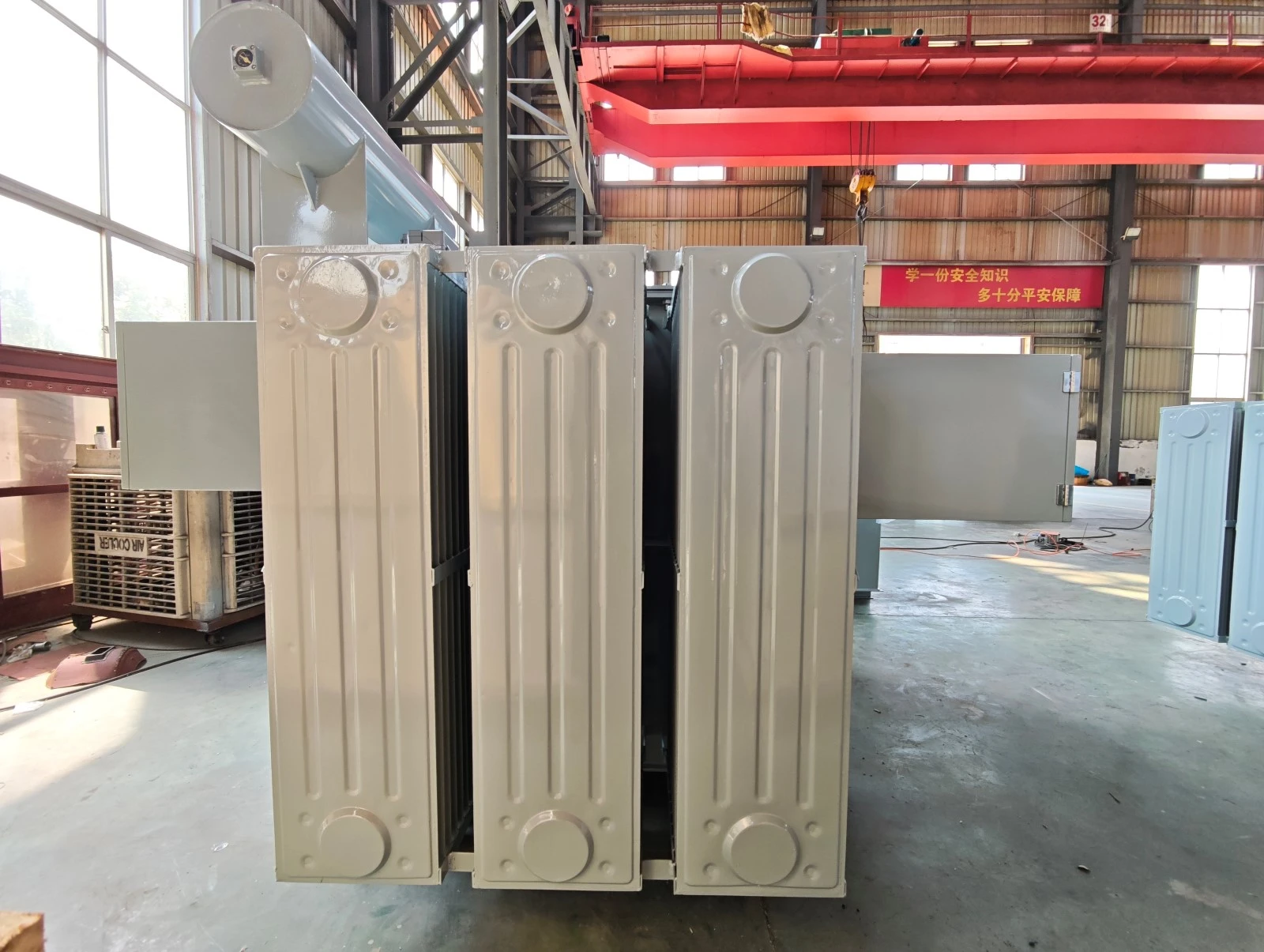
JINSHANMEN TECHNOLOGY CO., LTD mainly produces oil immersed power transformers, dry-type power transformers, oil immersed three-dimensional coiled power transformers, dry-type three-dimensional coiled power transformers, mining explosion-proof dry-type transformers, mining explosion-proof mobile substations, amorphous alloy power transformers, on load capacity regulating power transformers, locomotive dry-type transformers, as well as prefabricated substations, modular substations, wind energy box type substations, high and low voltage switchgear and other transmission and distribution equipment. In the power transmission and distribution system, voltage regulation is a core technology to ensure stable operation of transformers such as 3 phase 100 kva transformer and 33kv to 11kv transformer. This article will elaborate on the definition, causes, methods and importance of transformer voltage regulation.
1. What is Voltage Regulation?
Transformer voltage regulation rate refers to the percentage change of the terminal voltage of the secondary winding when the transformer operates at no-load and full-load. It measures the ability of the transformer to maintain stable output voltage, which is also an important performance indicator for transformers such as 3 phase 100 kva transformer.
Key concepts related to voltage regulation:
a. No-load voltage: The output voltage when the rated voltage is applied to the primary side of the transformer and the secondary side is open-circuited (no load connected).
b. Full-load voltage: The output voltage when the rated voltage is applied to the primary side and the secondary side is connected to the rated load (rated current, rated power factor). For 33kv to 11kv transformer, the full-load voltage stability directly affects the power supply quality of the distribution network.
2. Why Does Voltage Change? (Fundamental Cause)
The fundamental reason for the drop in output voltage from no-load to full-load lies in the internal impedance of the transformer, mainly the winding resistance and leakage reactance. When the load current flows through these impedances, a voltage drop will occur. This phenomenon is common in various transformers including 3 phase 100 kva transformer.
There are two main types of voltage drops:
a. Resistive voltage drop (I × R): Caused by the resistance of the winding conductor, in phase with the load current.
b. Reactive voltage drop (I × X): Caused by the inductive reactance from the transformer's leakage flux, with a phase difference of 90° from the load current.
The vector sum of these two voltage drops leads to changes in the secondary terminal voltage. The power factor of the load has a significant impact on this change:
a. Inductive load (lagging power factor): The voltage drop is the largest, and the voltage regulation rate is the highest.
b. Resistive load (power factor = 1): The voltage drop is small.
c. Capacitive load (leading power factor): The output voltage may even rise, and the voltage regulation rate may be negative. This characteristic needs to be considered in the voltage regulation design of 33kv to 11kv transformer.
3. How to Perform Voltage Regulation? (Methods)
In practical power systems, to ensure that the user-side voltage is within the allowable range, it is necessary to actively adjust the output voltage of the transformer. This is achieved through tap changers, which are widely used in JINSHANMEN TECHNOLOGY's transformer products such as 3 phase 100 kva transformer.
3.1 Principle
Change the number of turns of the high-voltage winding (because the current on the high-voltage side is small, the switch design is easier), thereby changing the transformation ratio of the transformer:
a. Increasing the number of high-voltage winding turns → increasing the transformation ratio → decreasing the secondary output voltage.
b. Reducing the number of high-voltage winding turns → decreasing the transformation ratio → increasing the secondary output voltage. This principle is particularly important for the voltage regulation of 33kv to 11kv transformer in distribution networks.
3.2 Types of Tap Changers
a. Off-load tap changer:
Commonly known as "power-off voltage regulation" or "no-load voltage regulation".Must be operated when the transformer is powered off and disconnected from the power grid.Usually provides a voltage regulation range of ±5% or ±2×2.5%.Simple structure and low cost, suitable for occasions with low requirements for voltage stability.
b. On-load tap changer:
Commonly known as "on-load voltage regulation" or "on-load tap changer (OLTC)".Can automatically or manually adjust the voltage when the transformer is energized and operating without power interruption.The internal structure is complex, including selectors, changers and transition circuits (such as reactance or resistance) to transfer load current and prevent arcing during switching.It is a key equipment for maintaining voltage stability in power grids and important users (such as factories, data centers). It usually can achieve a voltage regulation range of ±10%, with each step adjusting 1.25% or 1.5%.

4. The Importance of Voltage Regulation
a. Ensuring power quality: National standards have clear regulations on user-side voltage deviation (such as ±5% or ±7%). Voltage regulation ensures that the voltage is within the qualified range and guarantees the normal operation of electrical equipment. For 3 phase 100 kva transformer used in industrial and commercial scenarios, stable voltage is the premise of equipment efficiency.
b. Optimizing power grid operation: By adjusting the transformer voltage, the reactive power flow in the power grid can be adjusted, line losses can be reduced, and the economy and stability of the entire power grid can be improved. 33kv to 11kv transformer, as an important link in the distribution network, its voltage regulation effect directly affects the overall efficiency of the power grid.
c. Adapting to load changes: The power grid load changes at all times, leading to voltage fluctuations. On-load voltage regulation transformers can track and compensate for such fluctuations in real time.
d. Protecting electrical equipment: Excessively high voltage will damage equipment insulation and shorten service life; excessively low voltage will cause motor overheating, dim lighting, and failure to start equipment. Scientific voltage regulation can effectively extend the service life of transformers and terminal equipment.
5. Summary
Definition: The percentage of the output voltage change of the transformer between no-load and full-load.
Fundamental cause: Load voltage drop caused by the resistance and leakage reactance of the transformer's internal windings, affected by the load power factor.
Core adjustment method: Tap changer (changing the number of turns of the high-voltage winding to change the transformation ratio).
Main types: Off-load voltage regulation (requires power-off operation) and on-load voltage regulation (energized operation, real-time voltage stabilization).
Main purpose: Maintaining the voltage stability of the power system, ensuring power supply quality, and reducing losses.
In short, transformer voltage regulation is not only a technical indicator to measure its performance (voltage regulation rate), but also a key operation to maintain power grid stability (voltage regulation through tap changers). JINSHANMEN TECHNOLOGY CO., LTD integrates advanced voltage regulation technology into various transformer products to provide reliable power supply solutions for global users.